

Grid-forming inverter market: USD 808.75 Mn 2025 to USD 1,431.61 Mn by 2032
Grid-forming Inverter Market
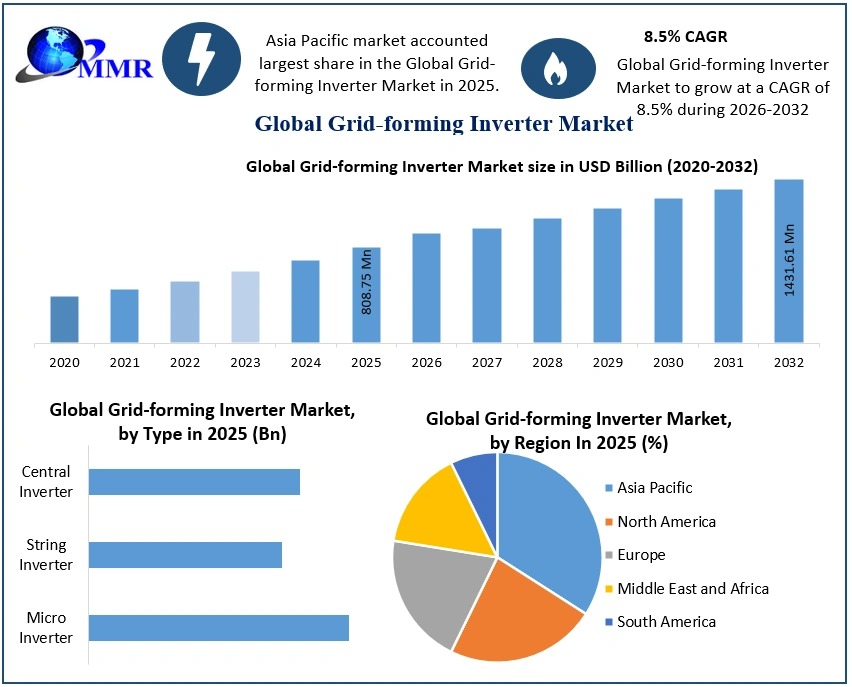
Grid-forming Inverter Market size was valued at USD 808.75 million in 2025 and is projected to reach nearly USD 1,431.61 million by 2032
"Revolutionizing power grids! Grid-forming inverters set to transform energy stability; discover the growth drivers with Maximize Market Research."
”
NEW YORK, NY, UNITED STATES, February 9, 2026 /EINPresswire.com/ -- Global Grid-forming Inverter Market size was valued at USD 808.75 million in 2025 and is projected to reach nearly USD 1,431.61 million by 2032, expanding at a CAGR of 8.5% during the 2025–2032. — Maximize Market Research
Grid-forming Inverter Market is set for strong growth, driven by rising renewable energy adoption, increasing demand for stable and resilient power grids, and technological advancements in inverter systems. Expansion is fueled by energy transition initiatives and the push for smart, reliable electricity infrastructure.
Request Free Sample Report @https://www.maximizemarketresearch.com/request-sample/237307/
Key Market Trends & Insights from the Grid-forming Inverter Market Report
Based on power rating, the above-100 kW segment dominated the grid-forming inverter market with the largest share in 2025.Utility-scale solar, wind, and battery storage projects are increasingly adopting high-capacity grid-forming inverter solutions to stabilize weak grids, manage frequency deviations, and support large-scale renewable integration. This segment is expected to remain the core revenue generator through the grid-forming inverter market forecast 2025–2032, as utilities transition toward inverter-centric grid architectures.
Utility-scale renewable projects are the primary demandcenter for grid-forming inverter solutions. Large solar and wind farms require grid-forming inverters for renewable energy integration to provide synthetic inertia, voltage support, and black-start capabilities. As grids move toward 60–80% renewable penetration, these inverters are becoming essential for maintaining operational stability in inverter-dominated networks.
Battery energy storage systems (BESS) areemerging as the fastest-growing application for grid-forming inverter technology. Grid-forming inverters for microgrids and energy storage enable autonomous grid operation, peak-shaving, and islanding capabilities. This trend is accelerating the adoption of grid-forming inverter for decentralized energy systems, especially in regions with high solar penetration or weak transmission infrastructure.
Asia-Pacific leads the global grid-forming inverter market, supported by aggressive renewable capacity additions and grid modernization programs.China, Japan, South Korea, and Australia are investing heavily in renewable energy grid stabilization solutions, positioning the region as both the largest demand center and the fastest-growing market during the forecast period.
Integrated PV-plus-storage grid-forming systems are redefining product strategies among leading manufacturers.Companies such as Huawei and Sungrow are introducing smart string grid-forming ESS technologies that combine solar generation, battery storage, and advanced control algorithms in a unified platform. This integration reduces system complexity and improves response times for grid services.
Software-driven control algorithms are becoming the primary competitive differentiator.Technologies such as virtual synchronous machine control, advanced droop control, and AI-assisted fault detection are transforming grid-forming inverters from hardware components into digital grid-stability assets. Vendors are increasingly competing on software capabilities rather than just power ratings.
Ancillary-service revenue streams areemerging as a new business model for grid-forming inverter deployments. Advanced inverters capable of frequency regulation, voltage control, and fast-response grid services are entering capacity and ancillary markets, transforming the grid-forming inverter market from a hardware-driven industry into a service-enabled energy platform.
High-Voltage, Storage-Driven Central Systems Lead the Grid-forming Inverter Market as Renewable Integration Reshapes Power Infrastructure
Global Grid-forming Inverter Market is rapidly segmenting across central, string, and micro architectures, with above-500 V systems and energy storage applications emerging as the strategic core of deployment. As utilities accelerate grid-forming inverter for renewable energy integration and grid-forming inverter for decentralized energy systems, high-capacity solutions are redefining grid stability solutions. This shift signals a new phase in the grid-forming inverter market forecast 2025–2032, where storage-centric, high-voltage platforms dominate.
By Type
Micro Inverter
String Inverter
Central Inverter
By Voltage
100-300 V
300-500 V
Above 500 V
By Application
Solar PV Plants
Wind Power Plants
Energy Storage System
Electric Vehicles
Request Free Sample Report @https://www.maximizemarketresearch.com/request-sample/237307/
Scope of the report includes below the technologies:
Grid-forming Inverter Technologies
• Grid-forming inverter architectures
o Voltage source inverters (VSI) with grid-forming control
o Current source inverters (CSI) with advanced control
o Hybrid grid-forming/grid-following inverters
Control strategies:
o Droop control
o Virtual synchronous machine (VSM)
o Matching control
o Dispatchable virtual oscillator control (dVOC)
Energy storage–integrated grid-forming systems:
o Battery energy storage system (BESS) inverters
o Hybrid solar-plus-storage grid-forming inverters
o Wind-plus-storage grid-forming systems
Grid Support and Stability Functions
• Synthetic inertia and fast frequency response
• Voltage regulation and reactive power support
• Black start capability
• Fault ride-through and grid stabilization features
Application-Based Deployment
• Utility-scale renewable energy plants
• Battery energy storage projects
• Microgrids and islanded power systems
• Commercial & industrial power systems
• Remote and off-grid electrification
Some of the technologies and solutions in the pipeline include:
Grid-forming Sunny Central Storage solutions by SMA Solar Technology AG
• Grid-forming inverter technology for large-scale BESS by Siemens Energy
• Grid-forming control systems by Hitachi Energy
• Grid-forming converters for microgrid applications by ABB
• Grid-forming inverters for renewable-storage plants by GE Vernova
• Megapack grid-forming inverter platform by Tesla
• Grid-forming BESS inverter solutions by Sungrow Power Supply Co., Ltd.
• Smart string grid-forming inverter technology by Huawei Digital Power
• Grid-forming energy storage systems by Wartsila
• Gridstack grid-forming storage inverter solutions by Fluence Energy
Global Grid-forming Inverter Market Heats Up as Enphase, Schneider Electric, GE, and Eaton Accelerate Decentralized, Storage-Driven Power Solutions
On January 30, 2025, Enphase Energy expanded global shipments of IQ8 Microinverters, strengthening residential grid-forming capabilities. On April 26, 2024, Schneider Electric launched a microgrid-ready BESS platform integrating storage, controls, and grid-forming inverters. On February 29, 2024, General Electric approved the GE Vernova spin-off to accelerate grid-forming infrastructure. On September 9, 2024, Eaton partnered with Tesla to deploy integrated, grid-interactive home energy systems supporting decentralised power architectures.
Asia-Pacific Leads; Europe Accelerates: How Renewable Integration and Storage Are Reshaping the Global Grid-forming Inverter Market
Asia-Pacific leads the global grid-forming inverter market,powered by giga-scale solar, wind, and storage clusters demanding grid-forming inverters for renewable energy integration and advanced grid stability solutions across rapidly urbanizing economies.
China, India, and Australia are accelerating grid-forming inverter for decentralized energy systems,as weak-grid conditions and storage-led projects reshape the grid-forming inverter market forecast 2025–2032.
Europe ranks second, driven by coal and nuclear retirements,offshore wind growth, and ancillary-service markets deploying grid-forming inverter solutions to stabilize low-inertia, renewable-dominated power systems.
Access Full Summary:https://www.maximizemarketresearch.com/market-report/grid-forming-inverter-market/237307/
Grid-forming Inverter Market, Key Players:
North America
Enphase Energy (USA)
Schneider Electric Solar (USA)
General Electric (USA)
Eaton (USA)
EPC Power Corp. (USA)
Morningstar Corporation (USA)
OutBackPower (USA)
Magnum Energy (USA)
SolarEdge Technologies (USA)
Europe
SMA Solar Technology AG (Germany)
Siemens Energy (Germany)
FIMER S.p.A. (Italy)
Fronius International GmbH (Austria)
Gamesa Electric (Spain)
Ingeteam(Spain)
KACO New Energy (Germany)
Victron Energy (Netherlands)
ABB Ltd. (Switzerland)
Power Electronics (Spain)
REFUsol(Germany)
EKS Energy (Spain)
Asia Pacific
Huawei Technologies Co., Ltd. (China)
SungrowPower Supply Co., Ltd. (China)
Delta Electronics, Inc. (Taiwan)
GoodWe(China)
GinlongTechnologies (China)
TBEA XinjiangSunoasisCo., Ltd. (China)
Hitachi Energy Ltd. (Japan)
SinengElectric Co., Ltd. (China)
Growatt(China)
FAQs:
What is the projected growth of the Grid-forming Inverter Market by 2032?
Ans: Global Grid-forming Inverter Market is expected to grow from USD 808.75 million in 2025 to USD 1,431.61 million by 2032, at a CAGR of 8.5%, driven by renewable integration and energy storage expansion.
Which segment dominates the market by power rating?
Ans: The above-100 kW segment leads, as it is widely used in utility-scale solar, wind, and storage projects requiring grid stability and synthetic inertia.
Which region leads the Grid-forming Inverter Market?
Ans: Asia-Pacific dominates due to large-scale renewable projects, rapid urbanization, and strong demand for decentralized, grid-forming energy systems.
Analyst Perspective:
Global Grid-forming inverter sector is entering a strategic growth phase as utilities and developers prioritize storage-integrated, software-driven power electronics to stabilize renewable-heavy grids. Returns are expected to concentrate around high-capacity, grid-services–ready platforms, intensifying competition among global inverter and energy-tech players. New investments are flowing into AI-based controls, hybrid PV-storage systems, and microgrid solutions, with Asia-Pacific leading adoption while Europe focuses on ancillary-service–driven deployment strategies.
Related Reports:
Inverter Duty Motor Market: https://www.maximizemarketresearch.com/market-report/inverter-duty-motor-market/261507/
Modular Inverter Market: https://www.maximizemarketresearch.com/market-report/modular-inverter-market/188459/
Power Inverter Market: https://www.maximizemarketresearch.com/market-report/power-inverter-market/168625/
About Maximize Market Research – Grid-forming Inverter Market:
Maximize Market Research delivers in-depth analysis of the Grid-forming Inverter Market within the Energy & Power domain, helping utilities, EPC firms, and technology providers navigate the transition toward inverter-dominated grids. Our insights focus on renewable integration, energy storage adoption, grid stability technologies, and emerging decentralized power architectures shaping next-generation energy systems.
Domain Focus – Energy & Power for Grid-forming Inverter Market:
Through data-driven research and strategic intelligence, Maximize Market Research supports stakeholders in identifying high-growth opportunities across grid-forming inverter technologies, storage-integrated solutions, and software-defined grid services. Our focused, revenue-impact studies enable energy companies to optimize investments, strengthen competitive positioning, and align with evolving global decarbonization and grid-modernization trends.
Lumawant Godage
MAXIMIZE MARKET RESEARCH PVT. LTD.
+ +91 96073 65656
email us here
Visit us on social media:
LinkedIn
Instagram
Facebook
X
Legal Disclaimer:
EIN Presswire provides this news content "as is" without warranty of any kind. We do not accept any responsibility or liability for the accuracy, content, images, videos, licenses, completeness, legality, or reliability of the information contained in this article. If you have any complaints or copyright issues related to this article, kindly contact the author above.
